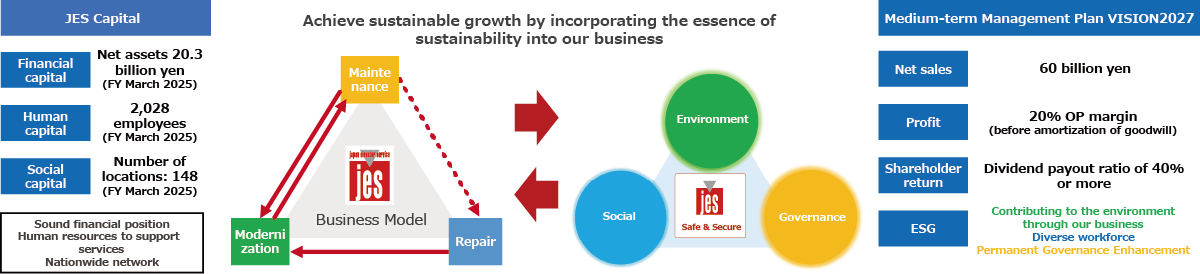
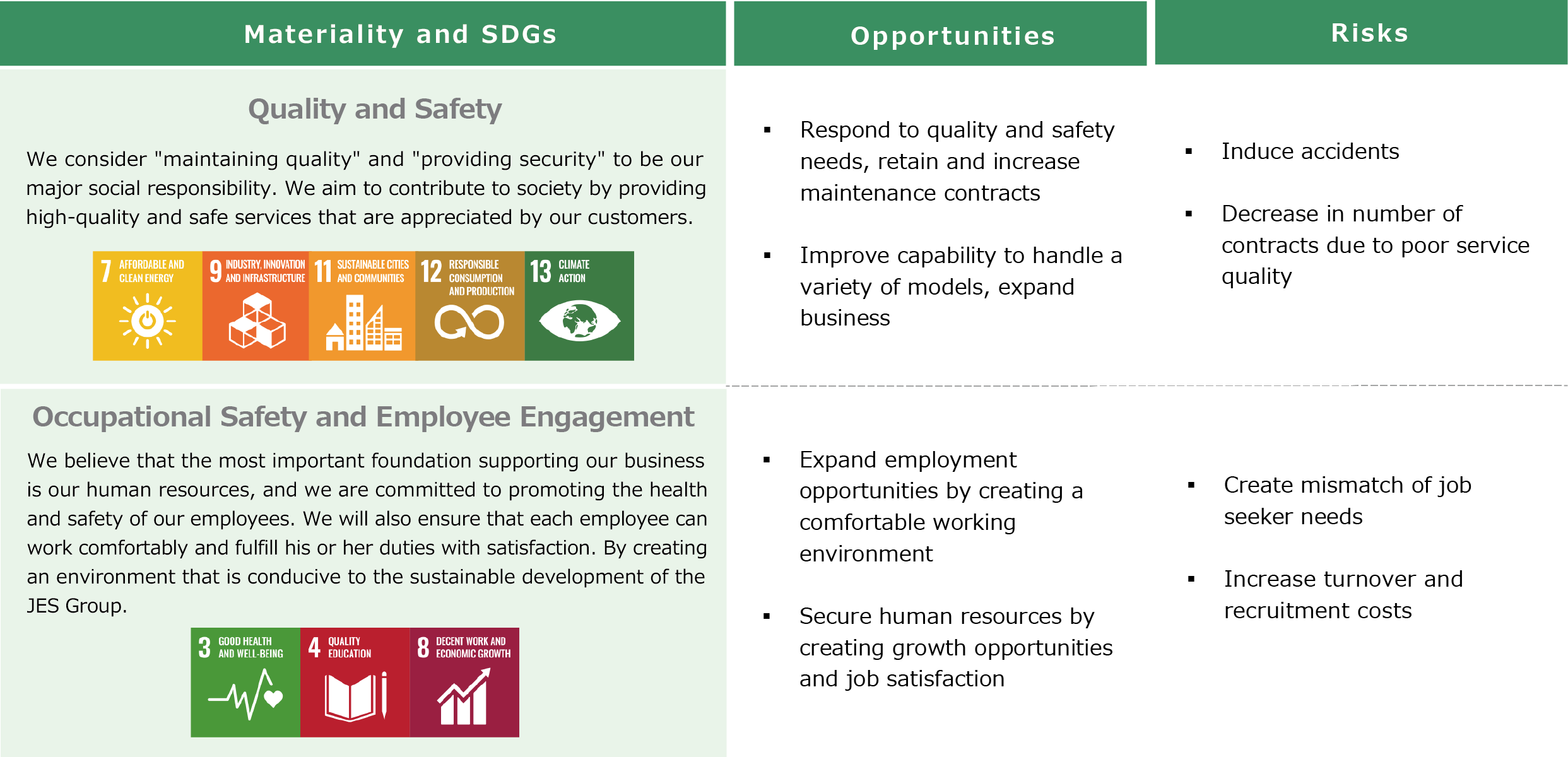
In an increasingly complex macro environment, with a declining birthrate, an aging population, the advance of digital transformation, and a market environment exacerbated by climate change, it is becoming increasingly difficult to predict the future. In order for the JES Group to develop sustainably in an uncertain and unpredictable society, we have set "quality and safety" in the elevator maintenance business and "occupational safety and employee engagement" that supports quality and safety it as materiality.
Today, companies are not only not valued solely on the basis of their pursuit of economic growth, otherwise they cannot even continue their business. Therefore, in its medium-term management plan VISION2027, the JES Group stipulated that it would promote activities aimed at solving social issues by incorporating ESG perspectives into its business, rather than just economic goals.
Social and environmental issues also affect our business. We are developing our business mainly in Japan. In Japan, we are facing a declining workforce due to the falling birthrate and aging population, and we recognize that this is an important issue in securing the human resources that will support our business growth. Given our market share in Japan and our history of growth, there is still plenty of room for expansion, but we recognize that acquiring and securing the human resources needed to do so is an issue that must be given top priority. In order to attract and retain human resources, it is important that the JES Group maintains an environment in which people want to work and are comfortable working, and it is necessary to be competitive over other companies. More than ever, the key point is to recognize the diversity of human resources in society and how we can demonstrate the appeal of the JES Group in that society.
Environmental challenges include the impact of extreme weather events due to climate change. In elevator maintenance, typhoons and other extreme weather events are highly likely to cause breakdowns, creating a risk of unavailability for users. We are checking elevator operating status and working to restore operations as appropriate, but we anticipate that the increased severity and frequency of extreme weather events would interfere with maintenance and increase the risk of affecting its users. We recognize that environmental issues caused by climate change will affect the JES Group's business, and we are determined to contribute to sustainability as much as we can as a company.
On September 11, 2025, the JES Group acquired certification from the Science Based Targets initiative (SBTi), an international climate change initiative, to reduce greenhouse gas emissions throughout the entire value chain to net zero by fiscal 2050.
As short-term targets, SCOPE1 + 2 targets a 54.6% reduction from the fiscal 2023 level by fiscal 2033, and SCOPE3 targets a 32.5% reduction from the fiscal 2023 level by fiscal 2033. The SCOPE1 + 2 target is a 90.0% reduction from the fiscal 2023 level by fiscal 2050, and the SCOPE3 target is a 90.0% reduction from the fiscal 2023 level by fiscal 2050.
Based on our corporate philosophy of "Safety Above Anything Else," "No Cutting Corners," and "Building on Trust," the JES Group has identified the two areas of materiality as "Quality and Safety" and "Occupational Safety and Employee Engagement". We will work to realize a sustainable society, and aim to become a company that is trusted and sought after by all of our stakeholders.
Recently, there has been growing interest in sustainability as a factor that leads to sustainable corporate growth and medium- to long-term value enhancement, and corporations are asked to proactively address issues related to sustainability and to disclose their activities.
The JES Group has established the Sustainability Committee to promote sustainability initiatives linked to the management plan by resolving materiality issues related to sustainability and identifying opportunities and risks. The Committee was chaired by the Director Deputy President CFO, and its members consisted of members deemed appropriate in light of the Committee's purpose and based on their assigned duties. The Committee will check for consistency of management and operations, as well as manage and oversee measures in conjunction with environmental, social, governance, and other sustainability issues.
The committee mainly deliberates on the formulation of the JES Group's sustainability strategies and plans, identify and assess risks, deliberate countermeasures and oversee its progress, set indicators to be used as targets, etc., monitor the status of initiatives and make reports and proposals to the Board of Directors.
In order to conduct business activities based on its corporate philosophy, the JES Group has established the Supplier Conduct Guidelines, which serve as its policy for addressing human rights, labor issues, and environmental issues.
We believe it is essential for all suppliers to understand the JES Group's approach and cooperate with us and comply with these guidelines in order to fulfill our corporate social responsibility and contribute to a sustainable society.
1. Policy
In order to conduct business activities based on its corporate philosophy, the JES Group has established the Supplier Conduct Guidelines, which serve as its policy for addressing human rights, labor issues, and environmental issues.
We believe it is essential for all suppliers to understand the JES Group's approach and cooperate with us and comply with these guidelines in order to fulfill our corporate social responsibility and contribute to a sustainable society.
- Prohibition of forced labor
Hire all employees at their will and do not force them to work. - Prohibition of child labor
No child under the minimum legal working age shall be employed. - Provision of a healthy, safe and sanitary working environmen
Provide a healthy, safe and sanitary working environment for our employees. - Respect for the right to collective bargaining
Respect the right of employees to organize and bargain collectively as a means of labor-management consultation on the working environment and wage levels. - Prohibition of discrimination
Eliminate discrimination in the employment of our employees and achieve fairness in their treatment. - Prohibition of harassment
Respect the human rights of employees and prohibit harassment of any kind. - Appropriate management of working hours
Appropriately manage employee working hours and leave, and prohibit excessive overtime work. - Ensure appropriate wages
Provide employees with decent living wage in compliance with the legal minimum wage. - Thorough prevention of corruption
Comply with all relevant laws and regulations and ensure the prevention of corruption. - Consideration of environment
When conducting business, consider the impact on local communities and biodiversity, and strive to conserve the global environment.
Consider climate change issues, efficient use of resources, waste reduction, and water use.
2. Response to noncompliance
If an instance of noncompliance of these guidelines is identified, the Group will request the supplier to take corrective measures, and provide guidance and support to the supplier.
If the non compliance persists after our guidance and support, the Group will reconsider the business with the supplier.
With growing concern about issues related to climate change and human rights, various ESG-related initiatives are being developed internationally to promote efforts to address social issues. We believe that the collaboration of companies around the world under the Initiative is the driving force behind our efforts to address international social issues. The JES Group participates in initiatives that encourage corporate efforts in the social context and promotes various initiatives to contribute to the realization of a sustainable society. Regarding climate change, we have set ambitious goals for carbon neutrality and are working to achieve them.
In accordance with their respective policies on "TCFD" and "SBT," we incorporate actions consistent with disclosure standards and future goals.
In November 2022, we expressed our endorsement of the TCFD.
In addition to disclosing information based on the TCFD recommendations, we will work to achieve environmental sustainability based on an analysis of business risks and opportunities based on these recommendations.

CDP is an international NGO that operates a global disclosure system to help investors, companies, nations, regions, and cities manage their environmental impacts. The JES Group recognizes its environmental impact and strives to achieve truly sustainable management through its responses to the CDP questionnaire.

The JES Group has set a goal of achieving net-zero greenhouse gas emissions across its entire value chain by fiscal 2050, and on September 11, 2025, received certification from the Science Based Targets initiative (SBTi), an international climate change initiative.
The Company endorses the aims of the "Conference on Building Partnerships for the Future" promoted by the Cabinet Office, the Ministry of Economy, Trade and Industry, the Small and Medium Enterprise Agency, and others, and has published a "Declaration on Building Partnerships".
The Company published its declaration in April 2024.

The Recognition Program for the Outstanding Organizations of KENKO Investment for Health is a system established by the Ministry of Economy, Trade and Industry in FY2016 with the aim of creating an environment in which corporations, including large or small and medium-sized companies, that practice particularly excellent health management can be evaluated by employees, job applicants, related companies and financial institutions by making them “visible". Based on the evaluation criteria established by the Study Group on the Promotion of KENKO Investment for Health (jointly organized by the KENKO Investment for Health Working Group of the Nippon Kenko Kaigi and the Hundred-Fifty-Thousand Health-Declaration Working Group), the Nippon Kenko Kaigi will certify “Outsitaning Organization of KENKO Investment for Health”.